
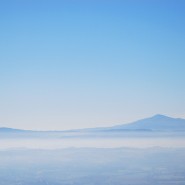
Welcome back! I’m a couple of days late in posting this week because I was flying back from Europe on my usual blog day! I thought I’d take a break from the more traditional travel photography images and talk about a landscape for a change. I must admit, however, I shot this photo when I was – you guessed it – traveling! This image was shot during a day trip to the small Tuscan town of Cortona, Italy in January 2013. I used an aperture of f/6.3 and a shutter speed of 1/640. Cortona is a beautiful medieval town that sits atop a large hill. It’s only a couple of hours away from Florence, so it’s a great day trip. The view from the top of the hill is spectacular. This particular day was a welcome break from the winter rain in Italy. If it had been overcast as it had been for many days leading up to and after this day, the experience would have been completely different. Despite the sun, the view of the Tuscan countryside was still very different than what I was expecting. A low, misty cloud had set in, blocking a complete view of the hills. As it turns out, this “obstructed” view was a huge stroke of luck. The shades of blue, soft lines, and faint details was breathtaking. As a rule, I don’t tend to shoot many landscapes. I can’t put my finger on why that is, other than the simple fact that I’m not drawn to landscapes in the same way that I’m drawn to architecture, geometric patterns, or people. This photo, however, was a welcome diversion from my typical subject. Something about the blue mist piqued my interest. I felt like I really “saw” the landscape, which is something that doesn’t happen to me very frequently in completely natural settings (not sure why!). This image ended up being a great memento from the day. When I look back, I can still feel the cool breeze on my face, the silence of the rolling hills, and the beautiful shades of blue. Thanks again for reading! Don’t forget to check back next...
Learn More
Welcome back! This photo was taken in the Old Jewish Cemetery in Prague, Czech Republic in 2008. I shot “Life and Death” with an aperture of f/5.6 and a shutter speed of 1/25, and shot with a Nikon D80. The image was recorded in black and white. Cemeteries are one of my favorite places to shoot photos. I think that there is something beautiful in the silence and stillness that overwhelmingly exists within a cemetery’s boundaries. Despite the silence, cemeteries have a way of saying so much to visitors about the history of the site and its inhabitants. Visiting cemeteries prompts an inner dialogue within myself that is full of questions. Why was this person buried in a mausoleum? How did this man live his life before his death? Who planted the tulips in front of this gravestone? It is questions such as these that inspire me to capture the essence of a cemetery by attempting to provide the silence with a voice. The Old Jewish Cemetery is one of the most remarkable cemeteries I’ve ever seen. It dates back to the 15th century and contains over 12,000 tombstones and some 100,000 bodies buried in 12 layers of graves. Despite the large population of burials, the cemetery itself is actually fairly small. It’s hard to fathom that so many were laid to rest in such a small area. Because the cemetery is completely crammed full of tombstones, there isn’t much room for anything else. There are a few trees and the occasional shrub, but the space overall is very bleak. When I saw this particular tombstone with a rare sign of life before it, I was struck by the juxtaposition of life and death. Despite the fact that the cemetery houses some 12 layers of burials, it still has the capacity to spring a flower up from the ground. If you ever find yourself in Prague, the Old Jewish Cemetery, along with the rest of the Jewish Quarter, is an amazing place to see. Tips for shooting in cemeteries: Remember that you are visiting hallowed ground that is very sacred for many people. While you are visiting as a photographer, I think that it is important to be conscious about being respectful of your surroundings. It might be tempting to shoot from an...
Learn More
Hi! As I’m sure you’ve figured out, this week’s photo depicts the famous Eiffel Tower in Paris, France. “The City of Light” was shot with an aperture of f/11 and a shutter speed of 3 seconds. I used a Nikon D80 and a Manfrotto 190xb tripod. If there was a list of the most challenging landmarks to photograph, the Eiffel Tower would definitely be included. With millions of visitors snapping photos of the tower, creating something unique is a huge challenge. I shot this photo on a weekend visit to Paris in late October 2008. I had been to Paris a couple of times before so I already had taken a few stabs at photographing some of the city’s most popular monuments – Notre Dame, Arc de Triomphe, the Louvre, and of course, the Eiffel Tower. But, I hadn’t yet been able to capture anything overly unique or interesting, so for this trip, I made it a goal to get away from the average depiction of such popular scenes. When I got to the Eiffel Tower, I was surprised to see that it was lit up with blue lights, rather than the usual golden color, and had a circle of stars on one side. Apparently, the blue color represented France’s six month presidency of the European Union. The blue lights ended up being a huge stroke of luck. In my quest for capturing something more unique, the fact that the Tower’s color was completely different than normal was a great start. I set up my camera and tripod to the southwest of the Tower, on one of the sidewalks in Champs de Mars, which is a large public park. I got there before it got too dark so that I would have a variety of lighting options, which ended up being really awesome because I got to see the Tower come to life. I read somewhere that when shooting landmarks and monuments, you should get your postcard pictures out of the way first. By postcard pictures, I mean those standard shots that every single visitor takes. By getting those postcard shots out of your system, you can then move into experimentation. I played around with shutter speed, aperture, focal length, and I shot a few in black...
Learn More
Welcome back! This week’s photo was shot on a very cold weekend in Amsterdam, Holland in November 2008. “Amsterdam Solarized” was shot with a Nikon D80 with an aperture of f/5.6 and a shutter speed of 1/250. I shot the photo in color and digitally converted it to black and white, and then used a method called solarization to further digitally transform the image. This photo is a bit of a departure from my typical photographic style. While I do edit all of my images with digital technology, most of my images are processed with minimal editing. This photo, however, is a little different. When I sat down to process this photo, I really wanted to create something dynamic. Solarization, which is a process that dates back to the days of traditional film photography and darkroom processing, seemed like the perfect method of achieving such dynamism. For those of you who don’t know, solarization is the reversal of an image’s tone so that black appears white and white appears black. In a traditional darkroom, it is extremely difficult to get consistent results. Digital technology, however, has made the process much more user friendly. With the right photo, solarization can transform a scene into a bold, provocative, and powerful image. While I don’t typically use Photoshop to achieve more involved processes such as this, at times it can be a huge asset in creating the kind of mood and energy desired. Images like this really make me question the boundary between digital photography and digital art. To me, when an image is over processed to the point that it is unrecognizable, it has moved into the realm of digital art. As such, I would argue that digital art and digital photography are two completely different art forms. Digital photography is the art of capturing a subject and enhancing what was naturally there with digital darkroom tools such as Photoshop. Digital art, however, is the art of capturing what the photographer sees in nature and transforming it into something completely different. I don’t want to compare the quality of the two different art forms, as there is no comparison – they are simply different. With the advancement of technology, the line between the two types of art becomes more and more unclear. Just in writing this blog entry...
Learn More
Hello! This week, I selected an image from one of my favorite places: Mykonos, Greece. I visited the island during a Greek island cruise in August 2011. I shot “Cycladic Capture” using a Nikon D80 with an aperture of f/4.8 and a shutter speed of 1/60. When I was in school, my photography professor talked a lot about the serendipity of photography; the accidental moments of good fortune that you never could have expected. This photo is probably my best example of a serendipitous moment. It is one of a handful of instances that the stars aligned and I found myself in a situation that magically presented a platter of perfect elements to photograph. During the Greek island cruise, we docked in Mykonos where I spent the day photographing the beautiful sky blue and white scenes that are synonymous with the Cycladic Islands. Mykonos was one of those places that I always wondered if it really looked as amazing in real life as it does in photographs. After experiencing it, I can honestly say that it is in fact even more stunning than it appears on the pages of travel magazines. While there were many people walking the narrow streets, the town had a very calm and laid back feeling about it. I know that Santorini gets much of the Cycladic Island glory, but I found Mykonos to be much more picturesque and serene. It was the end of the day and I had just sat on the shore and watched the sun go down. As I gathered my belongings, I looked up and saw this small domed church with a beautiful stained glass window on one side. I started heading towards the church to photograph the window (if you’ve looked at my Doors & Windows portfolio, I’m sure you noticed that I have a fascination with windows) and I saw that there was a man sitting on the bench right in front. I quickly realized, it wasn’t just a man…it was THE man. With his hat, sky blue shirt, gray hair, and mustache, he looked like the quintessential Greek island resident. It legitimately felt like he was magically dropped on that bench at the perfect moment specifically so that I could photograph him. Normally when I photograph people, I am very careful to be as...
Learn More
Hey there! As you may have guessed, “Reflection” was taken in Venice, Italy. I shot this photo on a trip to Italy in December 2012. I used a Nikon D80 with an aperture of f/7.1 and shutter speed of 1/200. Venice is one of my favorite places to explore. The winding maze of canals, bridges, and narrow streets coupled with beautiful architecture and rich history makes for a wonderful place to get completely lost in. With its lack of cars and streets, Venice is unlike just about anywhere in the world. I had been to Venice before, but this trip was unique because I was visiting in the winter. Before arriving, I was a little worried about the weather and the possibility of the city being flooded from high water levels. My concerns were realized the first two days. It really was a wet, foggy mess. Don’t get me wrong, the city was still beautiful. The fog and lack of crowds helped to create an air of mystery and intrigue that isn’t apparent during the warm summer months of peak tourist season. However, I found myself longing for the bright Italian sun to illuminate the sinking city. On the morning of last day of the trip, I walked outside of the hotel, and received one of the greatest gifts of travel…the sun! I was so excited that I was practically running, camera in tow, to start photographing the illuminated canals. That day, I went everywhere, and I do mean everywhere. North, south, east, and west…I covered it all. One of my favorite discoveries was an area right next door to the train station: the Jewish Ghetto. The area is a very interesting juxtaposition with the hustle and bustle of the train station. As soon as you cross the small canal that separates the Santa Lucia station with the Jewish Ghetto, it’s as if you’re crossing into a completely different city. It’s quiet, it’s calm, and it’s peaceful. In a city that is so overrun by tourists, it really felt like the “real” Venice. Because of the serene setting, I was able to capture this reflection. I feel like this photo sums up the essence of Venice. It has the canal, boats, a...
Learn More
Welcome back! For my first photo discussion, I decided to choose a photo taken in one of my very favorite cities: London. I shot “London Eye By Night” in September 2011 during a short stop over in London on the way home from Italy. This photo was shot with a Nikon D80 at f/11 for an exposure of 25 seconds. I used a Manfrotto 190xb tripod. I went to Westminster Bridge with the idea of photographing Big Ben and the Houses of Parliament. I planned on taking a few shots of the London Eye as well, but it wasn’t my focus. When I got to the bridge, I quickly realized that Big Ben wasn’t in the cards. I took a few shots at various apertures and shutter speeds only to find each photo to be completely blurred. Now for those of you that don’t know, Westminster Bridge is a heavily traveled bridge by both vehicles and pedestrians. As such, maintaining a completely still surface is next to impossible because of the incessant flood of busses and cars. Each shot was getting blurred because the tripod was moving as cars sped by. So, I had to rethink my strategy. I figured the best chance I had to eliminate camera shake was move my tripod to the edge of the bridge, as far away from traffic as possible. By the time I reset my tripod and camera, I decided to shift gears and focus on the London Eye. Alas, more problems. Westminster Bridge is lined by large street lamps, which added yet another obstacle in getting my shot. Each of the lamps produced such horrible lens flare that it seemed like a halfway decent shot of the Eye was impossible. After a few minutes of thinking, it occurred to me, why not use the lens flare as a way to enhance the Eye? So, I moved my tripod so that the flare essentially acted as a frame for the giant ferris wheel and began shooting. After the first shot, I knew instantly that I was on to something. I played with the aperture and shutter speed, moved my tripod to pick up different patterns of flare, and ultimately ended up with this shot. People...
Learn More
Hello and welcome to my blog! This has been well over a year in the making and I’m so excited to have my website finally up and running. I want to say a huge thank you to David DiJanni, an extremely talented graphic designer, for building this site. If anyone is in need of a creative graphic designer, he’s your man! I also want to say thank you to my photography professor and friend Jim Flory forcontinually supporting me through the years. I wouldn’t be the photographer that I am without his guidance. Finally, a big thank you to my family and friends for their continual support and encouragement. Words cannot describe how much they mean to me. If you’ve taken the time to look through each of my digital portfolios, I’m sure you’ve noticed that the majority of my work was captured while traveling. Even in the case of my “non-travel” photos such as landscapes or abstracts, I’d say about 90% of my work was captured while traveling. Travel is a huge passion of mine. Getting away from the ordinary and experiencing different cultures, landscapes, foods, colors, and so on is very inspiring. I’ve found that travel, coupled with photography, is the ideal way to experience a destination. Photography as a medium requires the user to focus on aesthetic details that can easily be overlooked. As such, I believe that travel photography allows for a holistic experience within a new setting that satisfies both the individual as a traveler, who sees a setting in a way that highlights both the colossal and obscure, and the individual as a photographer, who is not purely focused on finding “that next shot” but is more focused on the overall experience. Henry Moore said, “One’s destination is never a place, but a new way of seeing things.” It just so happens that my “new way of seeing things” is a direct result of the combination of travel and photography. As such, this blog is going to be a combination of photography and travel. Each week, I will post an image and share the story behind its capture, as well as the technical photographic elements involved. I hope that this blog will serve as inspiration to others to pick up a...
Learn More
Recent Comments